Cambridge Write and Speak by BartLabs
Stop Guessing What examiners want.
You're preparing for a Cambridge exam but don't feel confident enough. Don't let unfamiliarity with what's actually being tested cost you marks. You need real, assessed practice in writing and speaking, not just general fluency. If your exam is coming up and your writing or speaking need work, this is for you.
If you also want to walk into the exam feeling ready, join the waiting list.
Receive a free essay check

Who you'll learn from.
I'm Bart. For fifteen years I've taught English and prepared people for exams — and trained the teachers who do it at the British Council and International House teaching and examination centers. My MA in Applied Linguistics was built around one question: how people actually raise their scores in high-stakes exams. I know first-hand what a marker is trained to reward.
MA, Applied Linguistics · British Council Teaching & Examination Centers · International House · certified teacher since 2012
How the course works.
Live Classes: One task, taken apart
Each session takes one speaking and one writing task type and breaks it down: what it is, how it's built, the register and language it needs, and exactly how it's scored.
You Write and Speak: Real tasks, real feedback
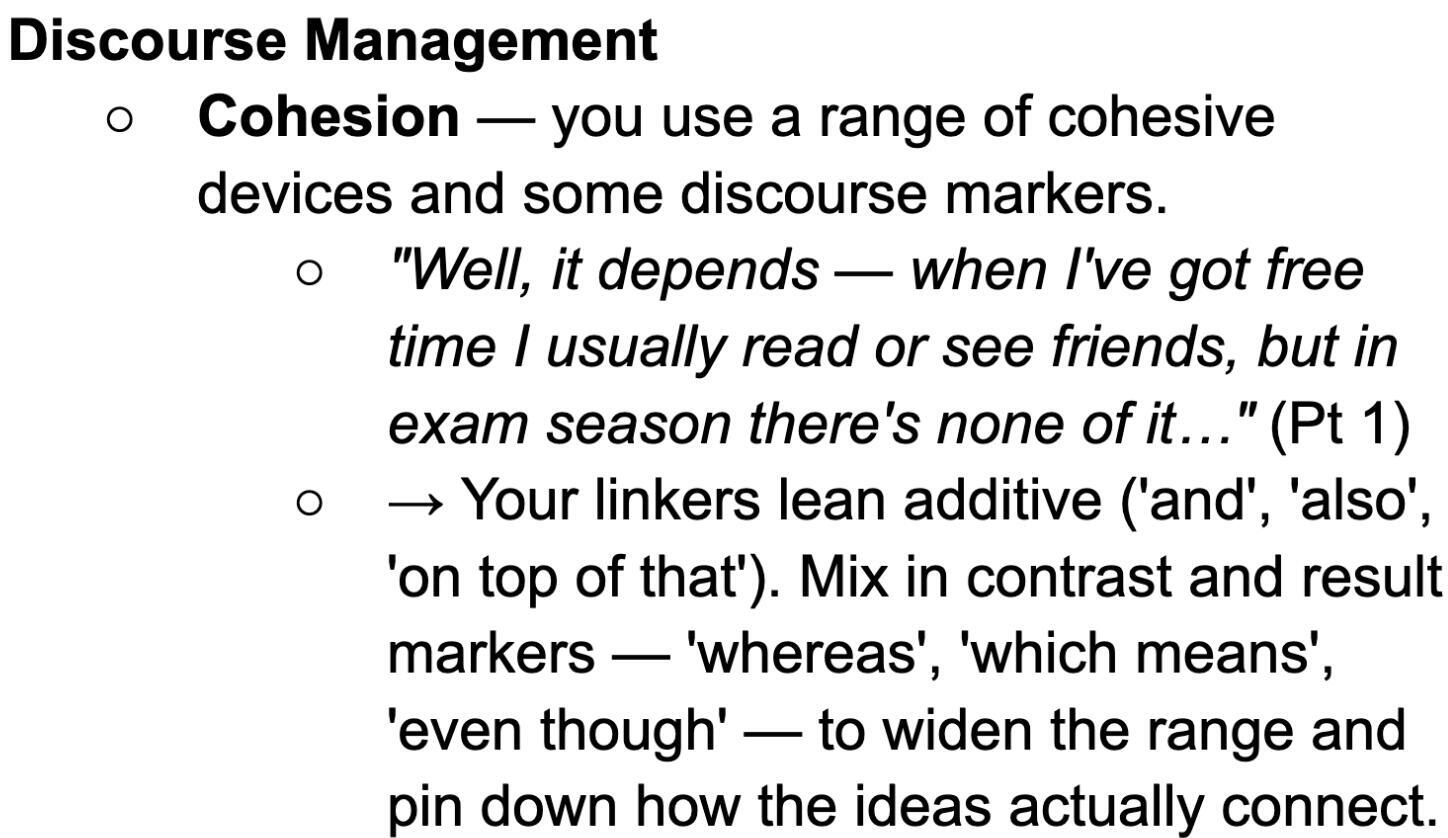
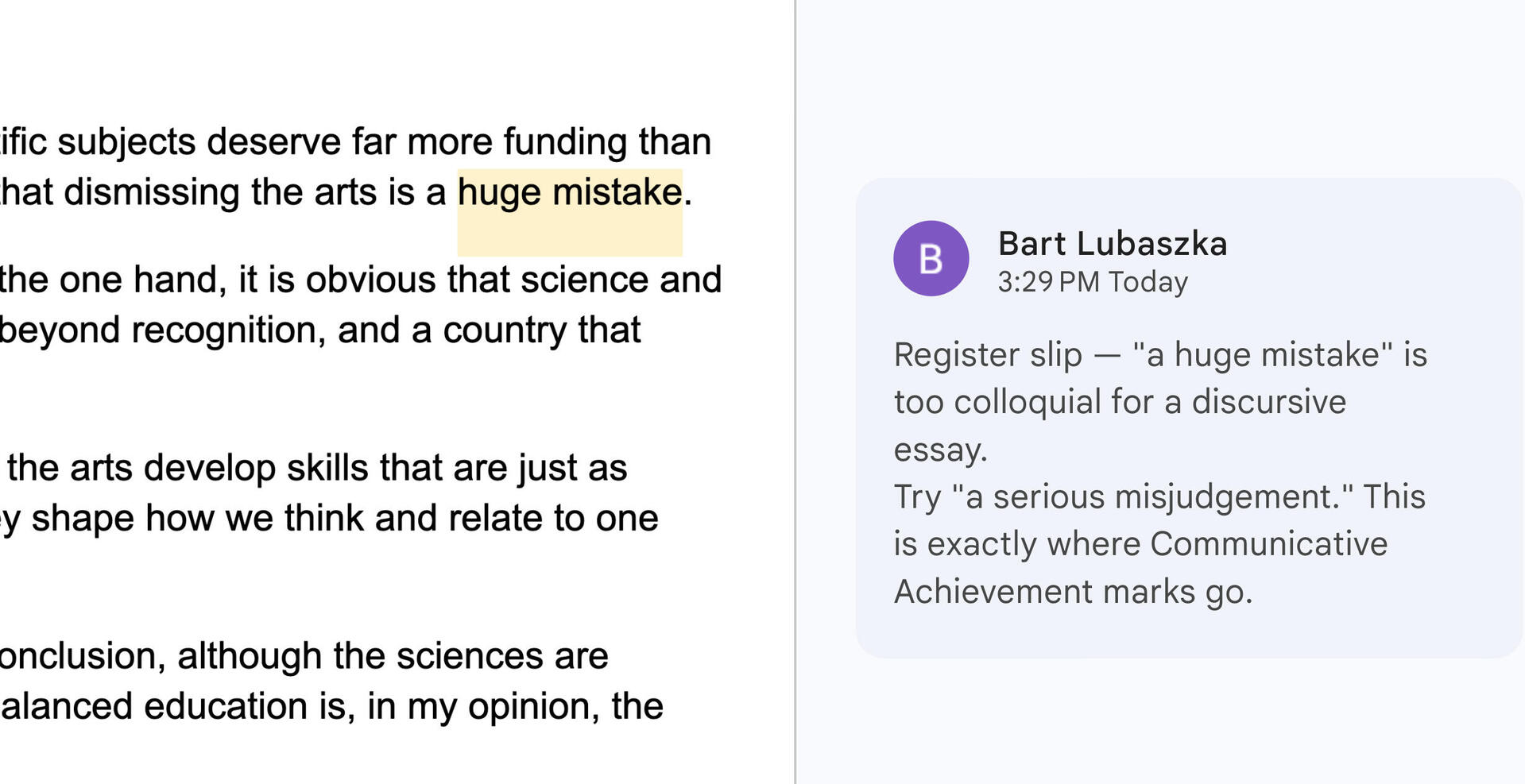
Between sessions you draft real exam writing tasks and receive feedback in shared Docs. Every session you also practice speaking with a partner — and take your turn being assessed.
Marked properly: Scored under exam conditions
Your speaking and writing mock is marked the way the real exam scores it, with notes on exactly where the marks went — and where the next ones are.
Small group: Capped at 8 students
Everyone gets seen. No hiding at the back, no lecture to a crowd — just a small, focused group of people improving together.
What you'll cover.
Master Writing.
01.
The essay
The one task everyone has to write — Part 1 at all levels. Discursive at C2.
02.
The report
Structure, headings, and the neutral register that scores. B2, C1 and C2.
03.
The review
Opinion with style, kept firmly on task. B2, C1 and C2.
04.
The email / letter
An email or letter at B2 and C1, in an informal, semi-formal, or formal register — a letter only, semi-formal or formal, at C2 — and knowing which the question wants.
05.
The article
Personal, engaging, and organized around your own experience or opinion — for B2 and C2.
06.
The proposal
Formal, structured, and persuasive — recommending a course of action for C1.
Master Speaking.
07.
The interview
Short questions about you — where you set the tone and show range.
08.
The long turn
A full minute on your own — comparing and speculating, not just describing.
09.
The collaborative task
A conversation with your partner — where the interaction counts, not winning.
10.
The discussion
Broader, more abstract questions — opinions developed and justified.
11.
The collaborative long turn (C2)
Photos and discussion shared with your partner — not a solo minute like B2 and C1's long turn.
12.
The prompt card discussion (C2)
A longer turn built from a prompt card, followed by discussion — C2 has three parts, not four.
Mock test.
You'll sit a mock and receive a report and private, one-to-one feedback from me.
"I highly recommend Bart for anyone preparing for the CAE exam. He identifies where I struggle and tailors exercises to overcome it, ensuring steady progress — and he's boosted my confidence using the language."
— Gabi · C1 Advanced prep · Preply
"He helped me improve my speaking, grammar and even writing — and believe me, I'm a tough one with writing."
— Olaf · C1 Advanced prep · Preply
"I'm preparing for the Cambridge B2 exam with Bart, and I can already see the progress after just a few lessons. 10/10."
— Anonymous · B2 First prep · British Council
Fluent English isn't the same as a high mark.
Most people don't lose marks because their English is weak.They lose them because no one ever showed them what the tasks actually reward—the shape of a report, the register of a review, the moves an examiner is trained to look for. You can write well and still walk out having dropped easy marks on a format you were never taught. The same goes for speaking: you can be fluent and accurate and still lose easy marks such as when describing when you're meant to compare and speculate or taking turns when you should be interacting.None of that is your English; it's the moves no one taught you—until now.
The offer.
Live course over Zoom, three times a week (Mon / Wed / Fri evenings), starting the first Monday of each month — two weeks, start to finish. Sessions run 17:00–21:30 CEST.
Includes
7 marked writing tasks
An assessed speaking slot, with a written report
A full writing + speaking mock
Personal, private feedback throughout
Early rounds: €100*
If you also want to walk into the exam feeling ready, join the waiting list.
with a free essay check for joining the waiting list
PRIVACY POLICYLast updated July 22, 2026This Privacy Notice for Bartlabs BARTŁOMIEJ LUBASZKA ("we," "us," or "our"), describes how and why we might access, collect, store, use, and/or share ("process") your personal information when you use our services ("Services"), including when you:- Visit our website at https://examprep.bartlabs.co or any website of ours that links to this Privacy Notice
- Use Write and Speak Lab. Write & Speak Lab is a live, small-group online course preparing students for Cambridge exams, run by BartLabs.
- Engage with us in other related ways, including any marketing or eventsQuestions or concerns? Reading this Privacy Notice will help you understand your privacy rights and choices. We are responsible for making decisions about how your personal information is processed. If you do not agree with our policies and practices, please do not use our Services. If you still have any questions or concerns, please contact us at [email protected].
* * *SUMMARY OF KEY POINTSWhat personal information do we process? When you visit, use, or navigate our Services, we may process personal information depending on how you interact with us and the Services, the choices you make, and the products and features you use. Learn more in Section 1 below.Do we process any sensitive personal information? Some of the information may be considered "special" or "sensitive" in certain jurisdictions, for example your racial or ethnic origins, sexual orientation, and religious beliefs. We may process sensitive personal information when necessary with your consent or as otherwise permitted by applicable law. Learn more in Section 1 below.Do we collect any information from third parties? We do not collect any information from third parties.How do we process your information? We process your information to provide, improve, and administer our Services, communicate with you, for security and fraud prevention, and to comply with law. We may also process your information for other purposes with your consent. We process your information only when we have a valid legal reason to do so. Learn more in Section 2 below.In what situations and with which parties do we share personal information? We may share information in specific situations and with specific third parties. Learn more in Section 4 below.How do we keep your information safe? We have adequate organizational and technical processes and procedures in place to protect your personal information. However, no electronic transmission over the internet or information storage technology can be guaranteed to be 100% secure, so we cannot promise or guarantee that hackers, cybercriminals, or other unauthorized third parties will not be able to defeat our security and improperly collect, access, steal, or modify your information. Learn more in Section 9 below.What are your rights? Depending on where you are located geographically, the applicable privacy law may mean you have certain rights regarding your personal information. Learn more in Section 11 below.How do you exercise your rights? The easiest way to exercise your rights is by contacting us at [email protected]. We will consider and act upon any request in accordance with applicable data protection laws.Want to learn more about what we do with any information we collect? Review the Privacy Notice in full below.* * *1. WHAT INFORMATION DO WE COLLECT?### Personal information you disclose to usIn Short: We collect personal information that you provide to us.We collect personal information that you voluntarily provide to us when you express an interest in obtaining information about us or our products and Services, when you participate in activities on the Services, or otherwise when you contact us.Personal Information Provided by You. The personal information that we collect depends on the context of your interactions with us and the Services, the choices you make, and the products and features you use. The personal information we collect may include the following:
- names
- email addresses
- contact preferences
- exam preparation details (exam type, exam date, exam history, and other responses provided in our intake form)
- recordings and transcripts of live class sessionsSensitive Information. When necessary, with your consent or as otherwise permitted by applicable law, we process the following categories of sensitive information:
- student dataAll personal information that you provide to us must be true, complete, and accurate, and you must notify us of any changes to such personal information.Information automatically collectedIn Short: Some information -- such as your Internet Protocol (IP) address and/or browser and device characteristics -- is collected automatically when you visit our Services.We automatically collect certain information when you visit, use, or navigate the Services. This information does not reveal your specific identity (like your name or contact information) but may include device and usage information, such as your IP address, browser and device characteristics, operating system, language preferences, referring URLs, device name, country, location, information about how and when you use our Services, and other technical information. This information is primarily needed to maintain the security and operation of our Services, and for our internal analytics and reporting purposes.Like many businesses, we also collect information through cookies and similar technologies.The information we collect includes:- Log and Usage Data. Log and usage data is service-related, diagnostic, usage, and performance information our servers automatically collect when you access or use our Services and which we record in log files. Depending on how you interact with us, this log data may include your IP address, device information, browser type, and settings and information about your activity in the Services (such as the date/time stamps associated with your usage, pages and files viewed, searches, and other actions you take such as which features you use), device event information (such as system activity, error reports (sometimes called "crash dumps"), and hardware settings).
- Device Data. We collect device data such as information about your computer, phone, tablet, or other device you use to access the Services. Depending on the device used, this device data may include information such as your IP address (or proxy server), device and application identification numbers, location, browser type, hardware model, Internet service provider and/or mobile carrier, operating system, and system configuration information.
- Location Data. We collect location data such as information about your device's location, which can be either precise or imprecise. How much information we collect depends on the type and settings of the device you use to access the Services. For example, we may use GPS and other technologies to collect geolocation data that tells us your current location (based on your IP address). You can opt out of allowing us to collect this information either by refusing access to the information or by disabling your Location setting on your device. However, if you choose to opt out, you may not be able to use certain aspects of the Services.
* * *2. HOW DO WE PROCESS YOUR INFORMATION?In Short: We process your information to provide, improve, and administer our Services, communicate with you, for security and fraud prevention, and to comply with law. We may also process your information for other purposes with your consent.We process your personal information for a variety of reasons, depending on how you interact with our Services, including:- To deliver and facilitate delivery of services to the user. We may process your information to provide you with the requested service.
- To respond to user inquiries/offer support to users. We may process your information to respond to your inquiries and solve any potential issues you might have with the requested service.
- To send administrative information to you. We may process your information to send you details about our products and services, changes to our terms and policies, and other similar information.
- To fulfill and manage your orders. We may process your information to fulfill and manage your orders, payments, returns, and exchanges made through the Services.
- To enable user-to-user communications. We may process your information if you choose to use any of our offerings that allow for communication with another user.
- To request feedback. We may process your information when necessary to request feedback and to contact you about your use of our Services.
- To send you marketing and promotional communications. We may process the personal information you send to us for our marketing purposes, if this is in accordance with your marketing preferences. You can opt out of our marketing emails at any time. For more information, see WHAT ARE YOUR PRIVACY RIGHTS? below.
- To protect our Services. We may process your information as part of our efforts to keep our Services safe and secure, including fraud monitoring and prevention.
- To identify usage trends. We may process information about how you use our Services to better understand how they are being used so we can improve them.
- To save or protect an individual's vital interest. We may process your information when necessary to save or protect an individual's vital interest, such as to prevent harm.
* * *3. WHAT LEGAL BASES DO WE RELY ON TO PROCESS YOUR INFORMATION?In Short: We only process your personal information when we believe it is necessary and we have a valid legal reason (i.e., legal basis) to do so under applicable law, like with your consent, to comply with laws, to provide you with services to enter into or fulfill our contractual obligations, to protect your rights, or to fulfill our legitimate business interests.The General Data Protection Regulation (GDPR) and UK GDPR require us to explain the valid legal bases we rely on in order to process your personal information. As such, we may rely on the following legal bases to process your personal information:- Consent. We may process your information if you have given us permission (i.e., consent) to use your personal information for a specific purpose. You can withdraw your consent at any time. Learn more about withdrawing your consent.
- Performance of a Contract. We may process your personal information when we believe it is necessary to fulfill our contractual obligations to you, including providing our Services or at your request prior to entering into a contract with you.
- Legitimate Interests. We may process your information when we believe it is reasonably necessary to achieve our legitimate business interests and those interests do not outweigh your interests and fundamental rights and freedoms. For example, we may process your personal information for some of the purposes described in order to:
- Send users information about special offers and discounts on our products and services
- Analyze how our Services are used so we can improve them to engage and retain users
- Diagnose problems and/or prevent fraudulent activities
- Understand how our users use our products and services so we can improve user experience
- Legal Obligations. We may process your information where we believe it is necessary for compliance with our legal obligations, such as to cooperate with a law enforcement body or regulatory agency, exercise or defend our legal rights, or disclose your information as evidence in litigation in which we are involved.
- Vital Interests. We may process your information where we believe it is necessary to protect your vital interests or the vital interests of a third party, such as situations involving potential threats to the safety of any person.
* * *4. WHEN AND WITH WHOM DO WE SHARE YOUR PERSONAL INFORMATION?In Short: We may share information in specific situations described in this section and/or with the following third parties.We may need to share your personal information in the following situations:- Business Transfers. We may share or transfer your information in connection with, or during negotiations of, any merger, sale of company assets, financing, or acquisition of all or a portion of our business to another company.
- Other Users. When you share personal information (for example, by posting comments, contributions, or other content to the Services) or otherwise interact with public areas of the Services, such personal information may be viewed by all users and may be publicly made available outside the Services in perpetuity. Similarly, other users will be able to view descriptions of your activity, communicate with you within our Services, and view your profile.Service Providers. We share personal information with the following third-party vendors and service providers who process it on our behalf, each for the specific purpose described below:Tally — processes form submissions (such as name, email address, and your responses) when you fill out an intake, feedback, or contact form.
Kit — processes your name and email address to send newsletters and marketing or course-related communications you've signed up to receive.
Zapier — may process and route personal information (such as form submissions or email addresses) between our other tools to automate parts of our workflow.
Anthropic (Claude) — processes written work, session transcripts, and related content as described in Section 6 ("Do We Offer Artificial Intelligence-Based Products?") and Section 13 ("AI Use, Recordings, and Transcripts") below.
Fastmail — hosts and processes email communications, including messages you send to or receive from us.
Carrd — hosts our website and processes information submitted through it, including form submissions.
Zoom — processes audio, video, and related data when you attend a live session, as described in Section 13 below.
Skool — processes your account and activity information if you participate in our online community hosted on that platform.
Stripe — processes payment and billing information (such as name, email address, and payment details) when you make a purchase or payment through our Services.
Umami — processes device and usage data (such as pages visited and general location) for privacy-focused, cookieless website analytics.Each of these providers processes personal information only to the extent necessary to perform their function for us, and is required to protect that information in accordance with applicable data protection law.
* * *5. DO WE USE COOKIES AND OTHER TRACKING TECHNOLOGIES?In Short: We may use cookies and other tracking technologies to collect and store your information.We may use cookies and similar tracking technologies (like web beacons and pixels) to gather information when you interact with our Services. Some online tracking technologies help us maintain the security of our Services, prevent crashes, fix bugs, save your preferences, and assist with basic site functions.We also permit third parties and service providers to use online tracking technologies on our Services for analytics and advertising, including to help manage and display advertisements or to tailor advertisements to your interests. The third parties and service providers use their technology to provide advertising about products and services tailored to your interests which may appear either on our Services or on other websites.Specific information about how we use such technologies and how you can refuse certain cookies is set out in our Cookie Notice.* * *
6. DO WE OFFER ARTIFICIAL INTELLIGENCE-BASED PRODUCTS?In Short: We offer products, features, or tools powered by artificial intelligence, machine learning, or similar technologies.As part of our Services, we offer products, features, or tools powered by artificial intelligence, machine learning, or similar technologies (collectively, "AI Products"). These tools are designed to enhance your experience and provide you with innovative solutions. The terms in this Privacy Notice govern your use of the AI Products within our Services.
Use of AI Technologies
We provide the AI Products through third-party service providers ("AI Service Providers"), including Anthropic. As outlined in this Privacy Notice, your input, output, and personal information will be shared with and processed by these AI Service Providers to enable your use of our AI Products for purposes outlined in WHAT LEGAL BASES DO WE RELY ON TO PROCESS YOUR PERSONAL INFORMATION? above. You must not use the AI Products in any way that violates the terms or policies of any AI Service Provider.
Our AI Products
Our AI Products are designed for the following functions:
* Text analysis
* Natural language processingHow We Process Your Data Using AI
All personal information processed using our AI Products is handled in line with our Privacy Notice and our agreement with third parties. This ensures high security and safeguards your personal information throughout the process, giving you peace of mind about your data's safety.
How to Opt Out
We believe in giving you the power to decide how your data is used. To opt out, you can contact [email protected]
We use AI tools to help analyze written work and session transcripts, and to refine our feedback process. Model training is disabled on our accounts, so this content is not used to train any models. Live session recordings are transcribed locally using MacWhisper, an on-device tool — audio is processed entirely on the instructor's computer and is not sent to any third party for transcription. The resulting transcript may then be analyzed further, as described above. AI is used for quality control and teacher development. Student work is read and analyzed by a human — your feedback always comes from your teacher, not an algorithm. If you'd prefer your submitted work or session transcripts not be analyzed using AI tools, you can opt out by contacting us.7. IS YOUR INFORMATION TRANSFERRED INTERNATIONALLY?
In Short: We may transfer, store, and process your information in countries other than your own.
Our servers are located in the United States. Regardless of your location, please be aware that your information may be transferred to, stored by, and processed by us in our facilities and in the facilities of the third parties with whom we may share your personal information (see WHEN AND WITH WHOM DO WE SHARE YOUR PERSONAL INFORMATION? above), including facilities in the United States, Belgium, Australia, Netherlands, India, and other countries.
If you are a resident in the European Economic Area (EEA), United Kingdom (UK), or Switzerland, then these countries may not necessarily have data protection laws or other similar laws as comprehensive as those in your country. However, we will take all necessary measures to protect your personal information in accordance with this Privacy Notice and applicable law.
European Commission's Standard Contractual Clauses:
We have implemented measures to protect your personal information, including by using the European Commission's Standard Contractual Clauses for transfers of personal information between our group companies and between us and our third-party providers. These clauses require all recipients to protect all personal information that they process originating from the EEA or UK in accordance with European data protection laws and regulations. Our Standard Contractual Clauses can be provided upon request. We have implemented similar appropriate safeguards with our third-party service providers and partners and further details can be provided upon request.
8. HOW LONG DO WE KEEP YOUR INFORMATION?In Short: We keep your information for as long as necessary to fulfill the purposes outlined in this Privacy Notice unless otherwise required by law.We will only keep your personal information for as long as it is necessary for the purposes set out in this Privacy Notice, unless a longer retention period is required or permitted by law (such as tax, accounting, or other legal requirements). No purpose in this notice will require us keeping your personal information for longer than: we retain your personal information for as long as you're an active student or subscriber, and afterward for as long as it may be useful for your potential return to a future course. You may request deletion or anonymization of your data at any time by contacting us.When we have no ongoing legitimate business need to process your personal information, we will either delete or anonymize such information, or, if this is not possible (for example, because your personal information has been stored in backup archives), then we will securely store your personal information and isolate it from any further processing until deletion is possible.* * *9. HOW DO WE KEEP YOUR INFORMATION SAFE?In Short: We aim to protect your personal information through a system of organizational and technical security measures.We have implemented appropriate and reasonable technical and organizational security measures designed to protect the security of any personal information we process. However, despite our safeguards and efforts to secure your information, no electronic transmission over the Internet or information storage technology can be guaranteed to be 100% secure, so we cannot promise or guarantee that hackers, cybercriminals, or other unauthorized third parties will not be able to defeat our security and improperly collect, access, steal, or modify your information. Although we will do our best to protect your personal information, transmission of personal information to and from our Services is at your own risk. You should only access the Services within a secure environment.* * *10. DO WE COLLECT INFORMATION FROM MINORS?In short: Under Polish law, individuals 16 and older may consent to the use of our Services themselves. Younger users may participate with the consent and supervision of a parent or guardian, though as an online service, we are not able to directly monitor or verify that involvement on an ongoing basis.In accordance with GDPR and Polish data protection law, individuals aged 16 and older may consent to our processing of their personal data themselves. Given that Cambridge exam preparation often involves students under 18, our Services may also be used by younger students where a parent or guardian is consents to their participation and supervises them.By using the Services, you confirm that you are 16 or older, or that a parent or guardian is aware of and consents to your use of the Services on that basis. Because our Services are delivered online, we are not able to directly verify or monitor whether a parent or guardian's involvement continues throughout a minor's participation -- this relies on the accuracy of the representation made at enrollment. If we become aware that a user under 16 is using the Services without appropriate parental consent, we will take reasonable steps to obtain that consent or, if that isn't possible, restrict or remove access. If you have questions about a minor's use of the Services, please contact us at [email protected].
* * *11. WHAT ARE YOUR PRIVACY RIGHTS?In Short: In some regions, such as the European Economic Area (EEA), United Kingdom (UK), and Switzerland, you have rights that allow you greater access to and control over your personal information. You may review, change, or terminate your account at any time, depending on your country, province, or state of residence.In some regions (like the EEA, UK, and Switzerland), you have certain rights under applicable data protection laws. These may include the right (i) to request access and obtain a copy of your personal information, (ii) to request rectification or erasure; (iii) to restrict the processing of your personal information; (iv) if applicable, to data portability; and (v) not to be subject to automated decision-making. In certain circumstances, you may also have the right to object to the processing of your personal information. You can make such a request by contacting us by using the contact details provided in the section HOW CAN YOU CONTACT US ABOUT THIS NOTICE? below.We will consider and act upon any request in accordance with applicable data protection laws.If you are located in the UK and are unhappy with how we have handled your personal information, you can make a complaint directly to us. This is in addition to the rights you have under the UK General Data Protection Regulation and the Data Protection Act 2018.How to contact us:- Online: <https://bartlabs.co/#contact>
- Email: [email protected]
- Post: See HOW CAN YOU CONTACT US ABOUT THIS NOTICE?What happens after you complain:- We will acknowledge your complaint within 30 days of receiving it.
- We will investigate without unjustifiable or excessive delay.
- We will keep you informed of progress and explain the outcome.If you are not happy with our final response, you can refer your complaint to the Information Commissioner's Office, the UK supervisory authority.- Website: ico.org.uk/make-a-complaint
- Helpline: 0303 123 1113
- Post: Information Commissioner's Office, Wycliffe House, Water Lane, Wilmslow, Cheshire, SK9 5AFIf you are located in the EEA or UK and you believe we are unlawfully processing your personal information, you also have the right to complain to your Member State data protection authority or UK data protection authority.If you are located in Switzerland, you may contact the Federal Data Protection and Information Commissioner.Withdrawing your consent: If we are relying on your consent to process your personal information, you have the right to withdraw your consent at any time. You can withdraw your consent at any time by contacting us by using the contact details provided in the section HOW CAN YOU CONTACT US ABOUT THIS NOTICE? below.However, please note that this will not affect the lawfulness of the processing before its withdrawal nor will it affect the processing of your personal information conducted in reliance on lawful processing grounds other than consent.Opting out of marketing and promotional communications: You can unsubscribe from our marketing and promotional communications at any time by clicking on the unsubscribe link in the emails that we send, or by contacting us using the details provided in the section HOW CAN YOU CONTACT US ABOUT THIS NOTICE? below. You will then be removed from the marketing lists. However, we may still communicate with you -- for example, to send you service-related messages that are necessary for the administration and use of your account, to respond to service requests, or for other non-marketing purposes.Cookies and similar technologies: Most Web browsers are set to accept cookies by default. If you prefer, you can usually choose to set your browser to remove cookies and to reject cookies. If you choose to remove cookies or reject cookies, this could affect certain features or services of our Services. For further information, please see our Cookie Notice.If you have questions or comments about your privacy rights, you may email us at [email protected].* * *12. CONTROLS FOR DO-NOT-TRACK FEATURESMost web browsers and some mobile operating systems and mobile applications include a Do-Not-Track ("DNT") feature or setting you can activate to signal your privacy preference not to have data about your online browsing activities monitored and collected. At this stage, no uniform technology standard for recognizing and implementing DNT signals has been finalized. As such, we do not currently respond to DNT browser signals or any other mechanism that automatically communicates your choice not to be tracked online. If a standard for online tracking is adopted that we must follow in the future, we will inform you about that practice in a revised version of this Privacy Notice.* * *13. AI USE, RECORDINGS, AND TRANSCRIPTSWe use AI tools (currently Claude by Anthropic) to help analyze written work and session transcripts, and to refine our feedback process. Model training is disabled on our accounts, so this content is not used to train any models. AI is used for quality control and teacher development -- student work is read and analyzed by a human, and your feedback always comes from your teacher, not an algorithm.Live sessions are held on Zoom, which may use built-in transcription and AI features to generate a transcript during the session.Recordings and transcripts may also be processed locally using MacWhisper, an on-device tool that does not send audio to any third party. Any transcript produced may then be analyzed further, as described above.Session recordings and transcripts are retained for as long as they may be useful for the instructor's reference (for example, reviewing past examples for teaching purposes), unless a student requests deletion of their data. Transcripts are used only by the instructor and the individual student for feedback purposes. Where session content is referenced with other students (for example, during class discussion), it is anonymized and not attributed to any individual.If you'd prefer your submitted work or session transcripts not be analyzed using AI tools, you can opt out by contacting us.* * *14. DO WE MAKE UPDATES TO THIS NOTICE?In Short: Yes, we will update this notice as necessary to stay compliant with relevant laws.We may update this Privacy Notice from time to time. The updated version will be indicated by an updated "Revised" date at the top of this Privacy Notice. If we make material changes to this Privacy Notice, we may notify you either by prominently posting a notice of such changes or by directly sending you a notification. We encourage you to review this Privacy Notice frequently to be informed of how we are protecting your information.* * *15. HOW CAN YOU CONTACT US ABOUT THIS NOTICE?If you have questions or comments about this notice, you may contact us by post at:Bartlabs BARTŁOMIEJ LUBASZKA Hallera 204/28 Wrocław, Dolnyśląsk 53-203 PolandEmail: [email protected]* * *16. HOW CAN YOU REVIEW, UPDATE, OR DELETE THE DATA WE COLLECT FROM YOU?Based on the applicable laws of your country, you may have the right to request access to the personal information we collect from you, details about how we have processed it, correct inaccuracies, or delete your personal information. You may also have the right to withdraw your consent to our processing of your personal information. These rights may be limited in some circumstances by applicable law. To request to review, update, or delete your personal information, please contact us at [email protected].